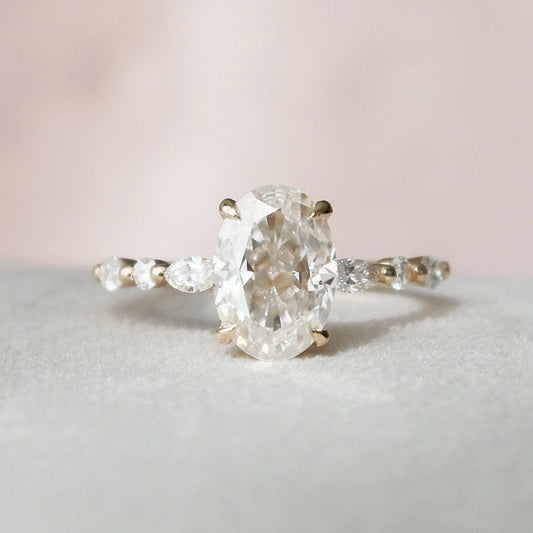
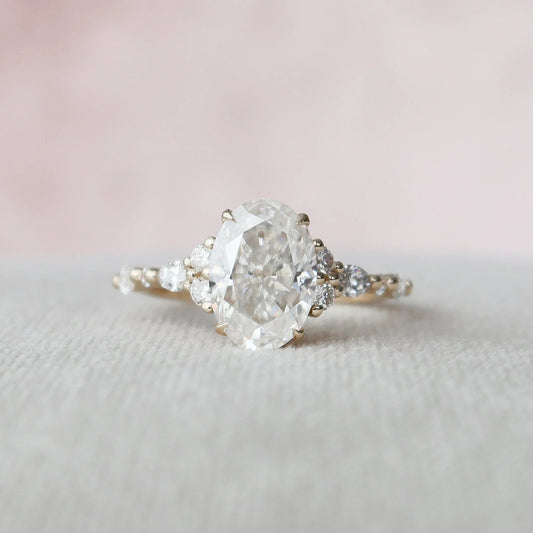
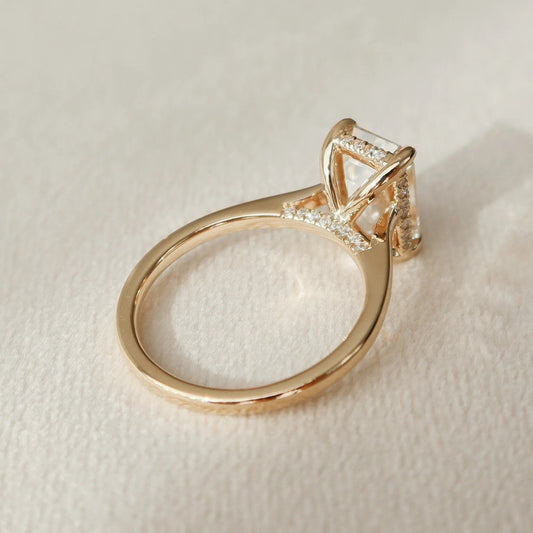
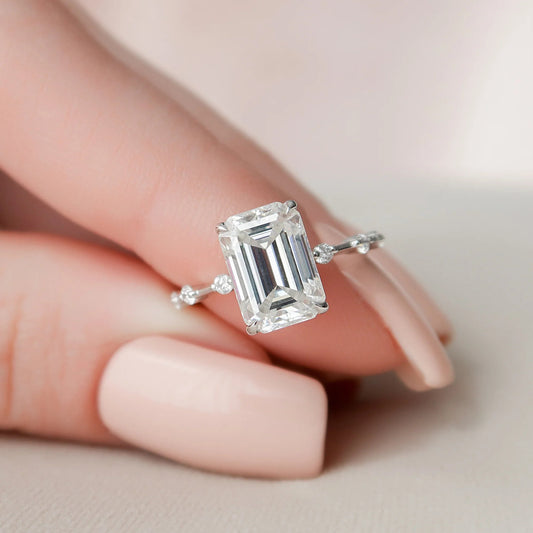
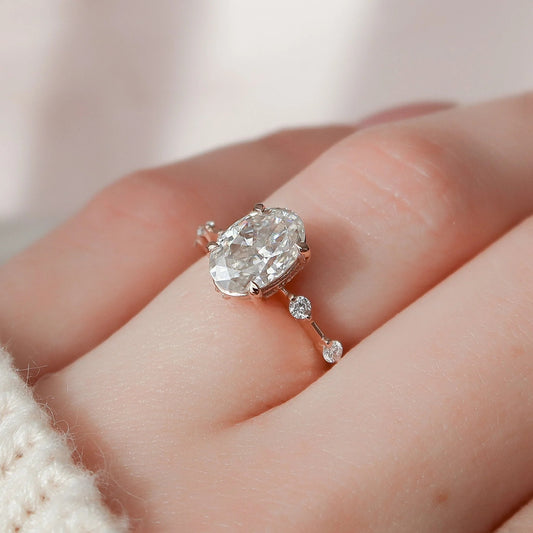
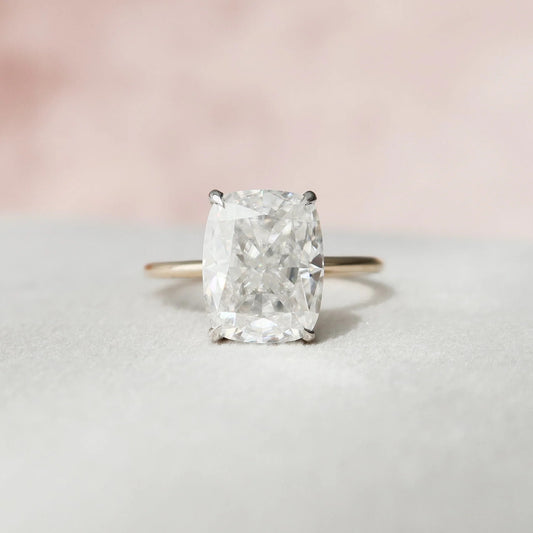
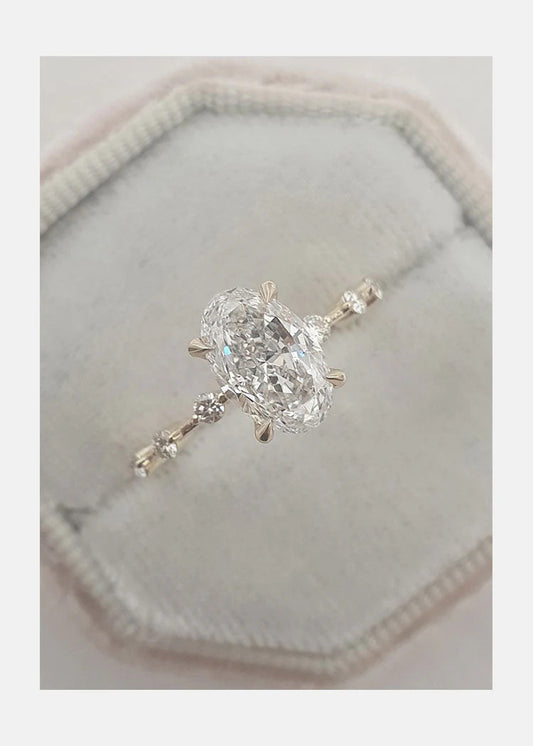
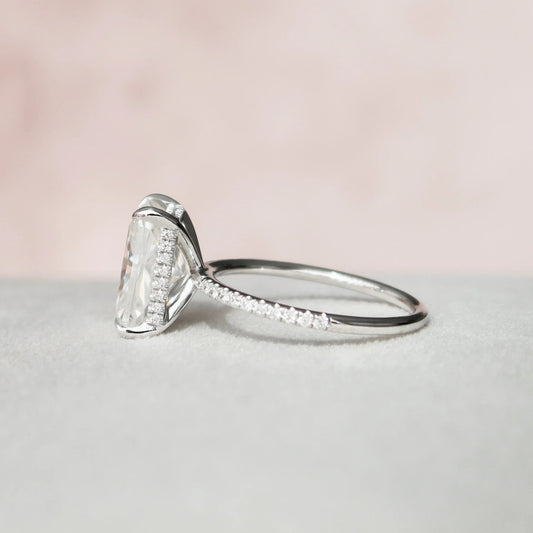
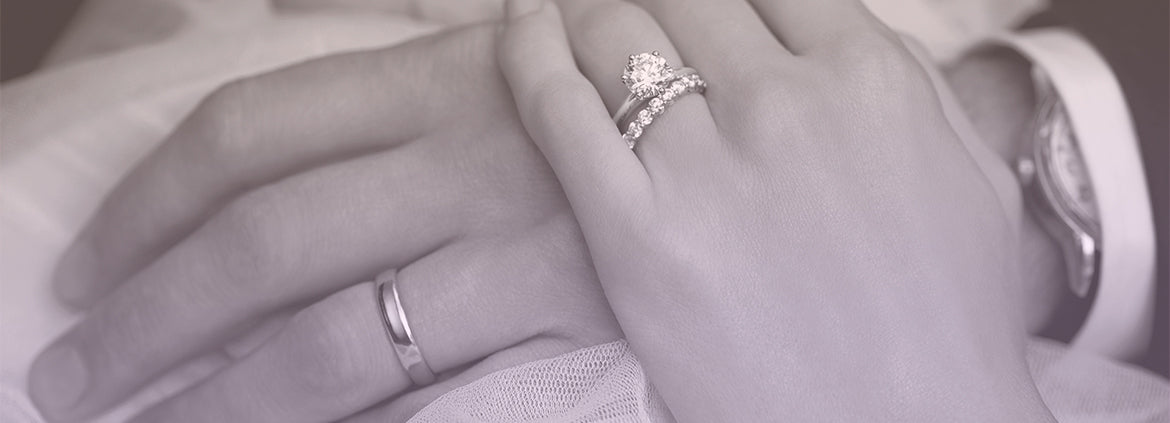
White Gold Moissanite Ring: The Sparkle-Per-Dollar Champion, Examined
Head-to-head comparisons settle arguments faster than adjectives. So this guide runs the white gold moissanite ring through five direct matchups, against diamond, against other metals, against its own quality tiers, so you finish knowing exactly what you would be buying and why.
First, the one fact that governs everything: moissanite is not a diamond. It is silicon carbide, a distinct gemstone with its own chemistry and its own optics, first identified by Nobel laureate Henri Moissan in 1893 in fragments from an Arizona meteor crater. Nearly all moissanite sold today is lab-created, because natural moissanite is vanishingly rare. Treating it as a "fake diamond" misses the point; treating it as its own stone reveals a remarkable one.
Matchup 1: Moissanite vs Diamond on Optics
The numbers:
- Refractive index: moissanite 2.65 to 2.69, diamond 2.42. Moissanite bends light more, producing more brilliance
- Dispersion (fire): moissanite 0.104, diamond 0.044. Moissanite throws over twice the rainbow flashes
- Lustre: both excellent, with diamond's adamantine lustre slightly more subdued and "white"
Translation: moissanite sparkles more and more colourfully. Whether that is a win depends on taste. Lovers of fireworks prefer moissanite's disco-ball fire; purists find diamond's balance of white light and restraint more elegant. In larger stones, above about 1.5 carats, moissanite's rainbow effect becomes noticeable to attentive eyes.
Matchup 2: Moissanite vs Diamond on Durability and Price
Hardness: diamond scores a perfect 10 on the Mohs scale; moissanite scores 9.25, harder than sapphire (9) and every other gemstone except diamond. Both handle daily wear for decades. Moissanite is also highly resistant to chipping and, usefully, to heat and household chemicals.
Price: this is the route. A quality 1-carat-equivalent moissanite typically costs a few hundred dollars, against thousands for a comparable lab-grown diamond and far more for a mined diamond. Note that moissanite is priced by millimetre size rather than carat, since it is about 15 percent lighter than diamond; a "6.5 mm" moissanite matches the face-up size of a 1-carat round diamond.
Honest caveat: Moissanite carries minimal resale value. It is a beauty purchase, never an investment, and any seller implying otherwise should lose your trust immediately.
Matchup 3: Why White Gold Specifically?
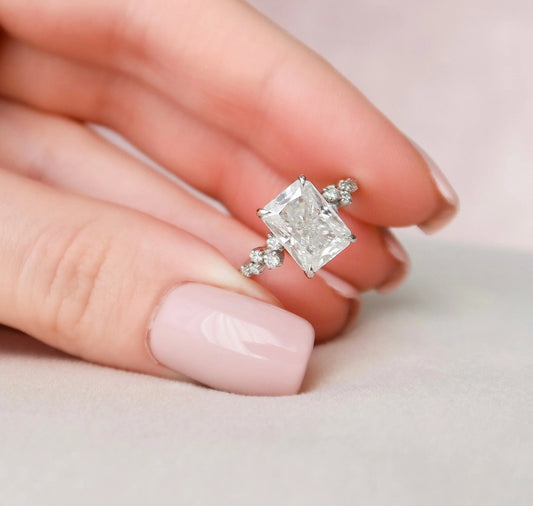
Moissanite's brilliance is icy and bright, and white gold extends that brightness seamlessly down the band, making the stone and setting read as one continuous flash. Yellow and rose settings contrast attractively too, but the white-on-white pairing is the classic for a reason: it maximizes the illusion of a bigger, brighter stone.
Practical notes for the metal half of the ring:
- Choose 14k white gold for durability at a friendly price
- Expect rhodium replating every one to three years to maintain the bright white surface
- Nickel-sensitive wearers should request nickel-free alloys or consider platinum
The finished combination undercuts a comparable diamond ring so heavily that many couples fund matching wedding bands from the savings alone.
Matchup 4: Moissanite Grade vs Moissanite Grade
Not all moissanite is equal. The market tiers roughly as follows:
- Premium colorless (D to F equivalent): the modern standard, fully white
- Near colorless (G to I equivalent): faint warmth, modest saving
- Older or unbranded stock: can carry a yellow or green tint, the source of most moissanite complaints
Cut matters as much as it does in diamonds; a well-proportioned round or oval maximizes the stone's famous fire. Reputable sellers state color tier, provide certificates of authenticity from the manufacturer, and offer lifetime warranties against clouding or color change, which quality moissanite does not do. Retailers with transparent specification pages, Atya Jewels among them, make these tiers easy to compare, and the same scrutiny applies whether you are buying a ring or moissanite accents alongside classic diamond earrings in a mixed jewellery wardrobe.
Matchup 5: Who Wins for You?
Choose the white gold moissanite ring if:
- Maximum sparkle per dollar is the priority
- You want a large, bright center stone without a five-figure spend
- The wearer loves fire and flash
- Budget freed from the stone can fund the honeymoon, the wedding, or a full coordinated suite such as bridal set wedding rings
Choose a diamond instead if the wearer prizes tradition, prefers subtler white sparkle, or would always quietly wish the stone were diamond. Sentiment is a legitimate specification. Many couples split the difference: a lab-grown diamond center from a curated range of engagement rings for the proposal, and moissanite for fashion pieces and travel rings.
The moissanite ring wins its matchups on physics and price. Whether it wins the proposal is, fittingly, a matter of the heart.
White Gold Moissanite Ring FAQs
Q1. Is moissanite a real gemstone?
Yes. It is silicon carbide, a distinct lab-created gemstone, not a diamond and not a fake.
Q2. Will moissanite get cloudy over time?
Quality moissanite does not cloud or change color, and reputable makers warranty this for life.
Q3. Can people tell moissanite from diamond?
Under close inspection, its stronger rainbow fire can hint at it, especially in large stones. Casually, rarely.
Q4. How hard is moissanite?
9.25 on the Mohs scale, second only to diamond among ring-worthy stones.
Q5. Why is moissanite measured in millimetres?
It weighs about 15 percent less than a diamond, so sellers quote size (like 6.5 mm) rather than carats for fair comparison.
Q6. Does a white gold moissanite ring need maintenance?
The stone needs only cleaning; the white gold needs rhodium replating every one to three years.